Cart
0
You may also like

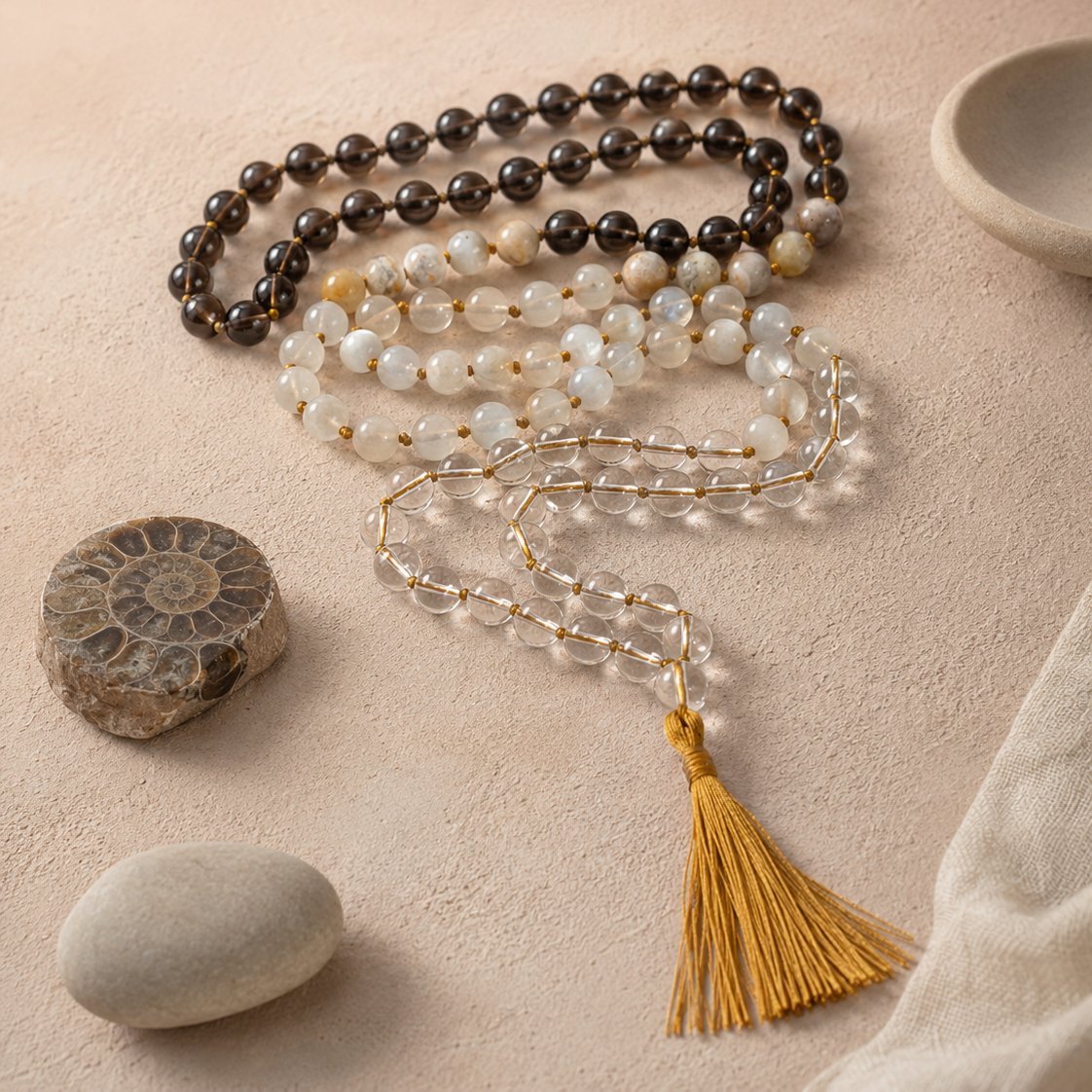
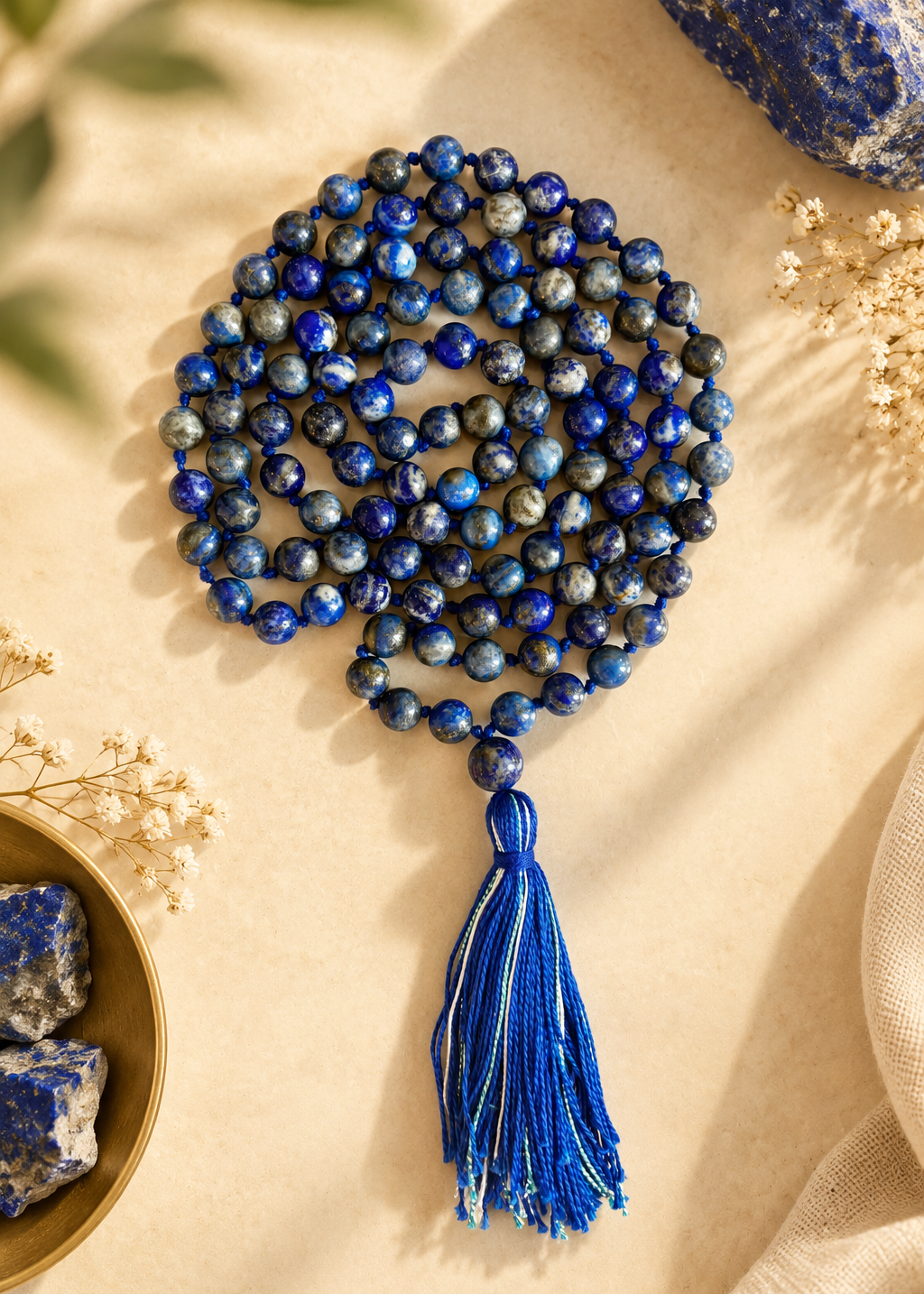
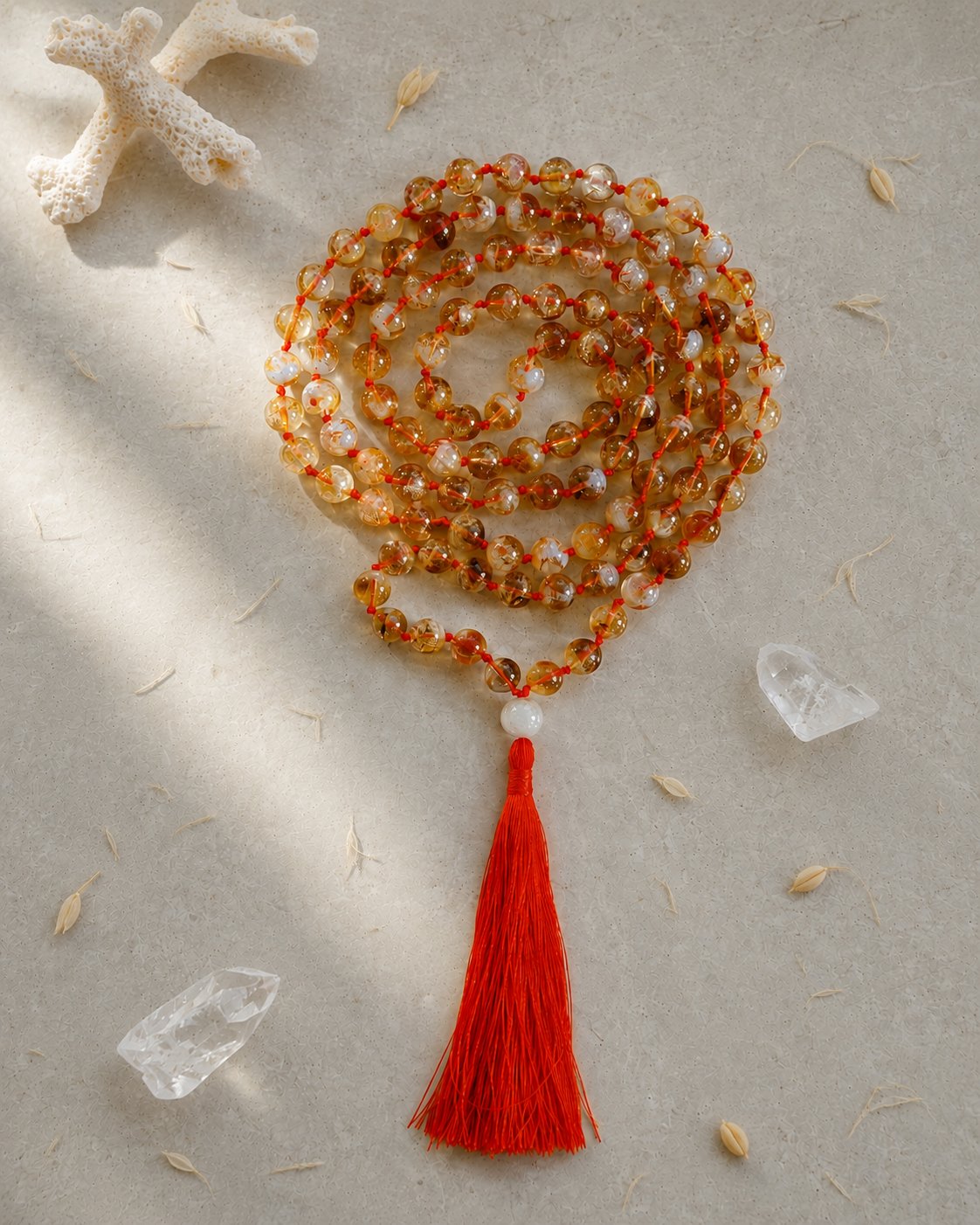





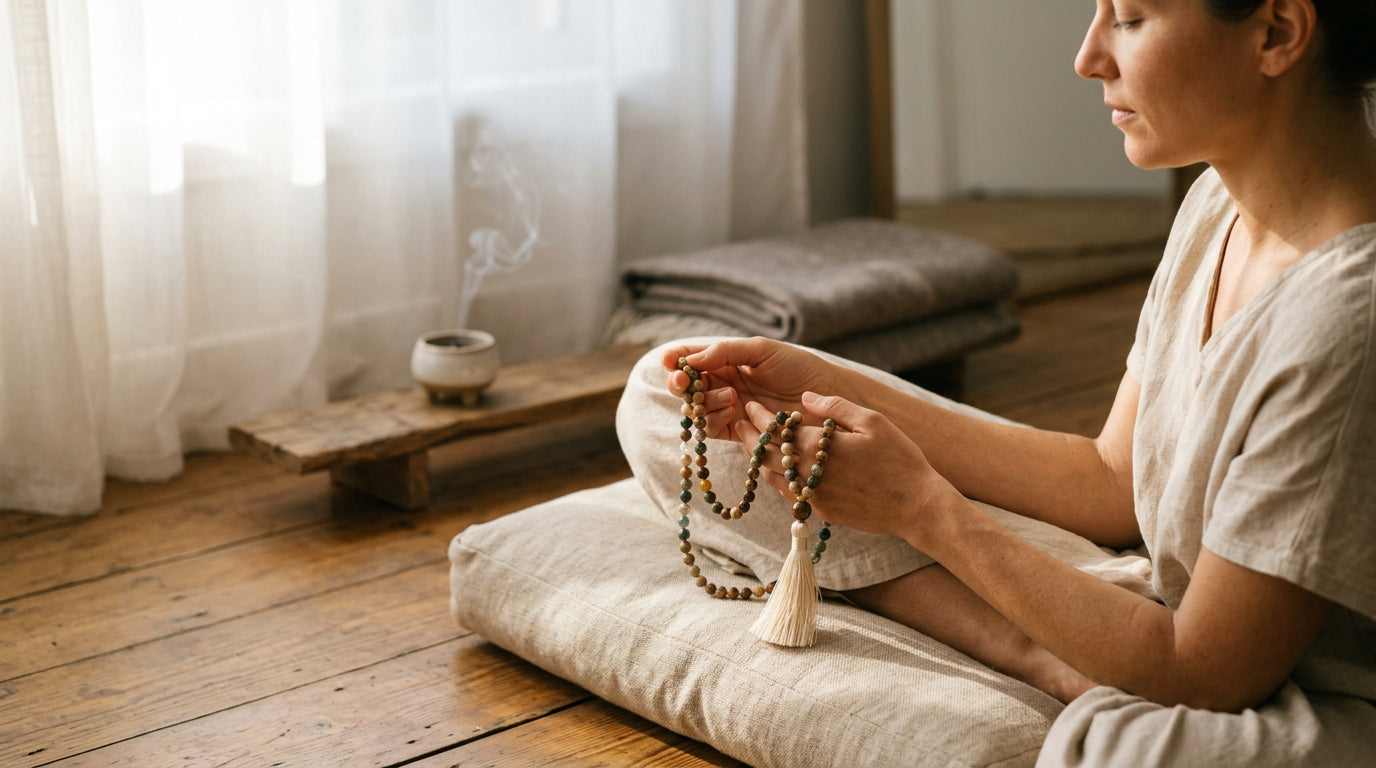
The extraordinary story of a number that appears everywhere — from the cosmos to your own body

When people first pick up a Japa mala, they almost always ask the same question.
"Why 108 beads?"
It's a fair question. Not 100, which feels round and logical. Not 120, which feels abundant. Not 99, which is common in other traditions. Always, specifically, 108.
The short answer is that 108 is considered one of the most sacred numbers in the universe — appearing with remarkable consistency across Hindu philosophy, Buddhist teaching, astronomy, mathematics, the human body, and ancient architecture. It is a number that seems to know something we don't.
The long answer is this entire blog post. And I promise you — by the end of it, every time you pick up your mala and feel those 108 beads pass through your fingers, the experience will feel entirely different.
Let's begin.
I want to start by saying something clearly: the convergence of 108 across so many different fields — astronomy, mathematics, sacred texts, human physiology — is genuinely astonishing. There are rational explanations for some of it, and for other parts, the explanation is simply that our ancestors were paying very close attention to the patterns of the universe. Closer, perhaps, than we give them credit for.
I'm not asking you to believe in magic. I'm asking you to stay curious. Because 108 is the kind of number that, once you start noticing it, you cannot unsee.
Let's start with the most jaw-dropping one.
The diameter of the Sun is approximately 108 times the diameter of the Earth. The average distance from Earth to the Sun is approximately 108 times the diameter of the Sun. The average distance from Earth to the Moon is approximately 108 times the diameter of the Moon.
Read that again. The same ratio — 108 — governs the relationship between our planet and both of the celestial bodies that make life on Earth possible. The Sun that gives us heat and light. The Moon that governs our tides, our cycles, our sleep.
This isn't numerological stretching. These are verified astronomical measurements. And ancient Vedic astronomers — working with nothing but naked-eye observation, water clocks, and extraordinary mathematical minds — calculated these ratios thousands of years before modern science confirmed them.
When our ancestors chose 108 as the number of beads on a mala, they were not choosing an arbitrary number. They were aligning the practice of mantra recitation with the geometry of the cosmos itself. Every time you complete a round of your mala, you are, in some sense, circling the universe.
In the Hindu tradition, 108 appears with extraordinary frequency across scripture, theology, and ritual. Here are some of the most significant:
The Upanishads
There are 108 Upanishads — the ancient philosophical texts that form the basis of Vedantic thought. These texts explore the nature of Brahman (ultimate reality), Atman (individual consciousness), and the relationship between the two. To recite a mantra 108 times is, in a sense, to honour all 108 of these paths to understanding.
The Names of the Divine
Many Hindu deities have 108 sacred names — including Vishnu, Shiva, Ganesha, and Lakshmi. Reciting all 108 names of a deity is considered a complete act of devotion — a full circle of honouring. A Japa mala with 108 beads makes this literally countable.
The Sacred Sites of India
There are 108 Divya Desams — sacred Vishnu temples across India and beyond, considered the holiest pilgrimage sites in Vaishnavism. There are also 108 Shakti Peethas — sites where the body of the goddess Sati is said to have fallen. To chant 108 times is to visit each of these sacred spaces in the geography of the mind.
The 108 Marma Points
Ayurvedic medicine maps 107 (some texts say 108) marma points across the human body — vital energy junctions where flesh, bone, vein, and nerve meet. These are the body's sacred geography, and stimulating them through yoga, massage, and breathwork is considered central to health and spiritual awakening.
The Gopis of Krishna
In the Bhagavata Purana, Krishna is described as dancing the Raas Leela with 108 Gopis (divine female companions) — each one a representation of a different aspect of devotion and love. The number 108 thus becomes associated with complete, whole-hearted devotion — which is exactly what japa practice cultivates.
Buddhism, which emerged from the same philosophical landscape as Hinduism, also carries 108 as a sacred number — though it frames it differently.
In Buddhist thought, there are said to be 108 earthly desires or defilements (kleshas) that bind human beings to suffering. The ringing of temple bells 108 times at the New Year — a practice common in Japan, Korea, and Tibet — is specifically intended to purify practitioners of these 108 defilements and welcome the new year with a clean, liberated mind.
There are also 108 volumes of the Kangyur — the Tibetan Buddhist canon containing the words of the Buddha. And in the Tibetan tradition, a mala of 108 beads (called a "mala" in Sanskrit or "trengwa" in Tibetan) is used for counting mantras, prostrations, and offerings — each bead a small act of remembrance and return.
Here's where it gets beautifully nerdy, and I am here for it.
108 is what mathematicians call a "hyperperfect number" — a number with very specific divisible properties. It is divisible by 1, 2, 3, 4, 6, 9, 12, 18, 27, 36, 54, and 108. That's 12 divisors — an unusually rich divisibility for a number of its size.
In sacred geometry, the interior angles of a regular pentagon measure 108 degrees. The pentagon, with its five-fold symmetry, is the geometric basis of the golden ratio — the mathematical proportion that appears in the spiral of a nautilus shell, the arrangement of seeds in a sunflower, and the proportions of the human face.
1 x 2 x 2 x 3 x 3 x 3 = 108. Or put another way: 1 to the power of 1, multiplied by 2 to the power of 2, multiplied by 3 to the power of 3. The first three integers, each raised to its own power. There's an elegant, self-referential completeness to this that ancient mathematicians found deeply satisfying.
Some scholars also note that 108 = 4 x 27. And in Vedic cosmology, there are 27 lunar mansions (Nakshatras) — the 27 segments through which the Moon moves across the sky in a lunar month. Each Nakshatra has 4 padas (quarters), giving 27 x 4 = 108. The Moon's journey through the sky, divided into its finest segments, adds up to 108. Again.
What makes 108 particularly compelling is that its significance isn't confined to Indian philosophy. Versions of this number appear across traditions with no obvious shared origin.
It seems that wherever humans looked carefully enough — at the sky, at the body, at scripture, at mathematics — they found 108 waiting.
In yogic physiology, the body is understood to contain a vast network of energy channels called nadis — subtle pathways through which prana (life force) flows. Different texts give different counts for the total number of nadis, but many traditions settle on 72,000. And the central channel — the Sushumna Nadi, which runs from the base of the spine to the crown of the head — is said to divide into 108 at the heart.
The heart. Of course it's the heart.
This is why in many traditions, the mala is held at the level of the heart during Japa practice. You are, symbolically, working with those 108 channels of the heart — clearing them, opening them, allowing prana to flow freely through them with each mantra repetition.
There's also the practice of pranayama (yogic breathwork) to consider: it is said that with 108 breaths of consciousness, a practitioner can move prana from the root chakra to the crown. One full mala round. One full awakening cycle.
All of this history, mathematics, and cosmology boils down to something very simple and very practical for your daily Japa practice:
When you sit with your mala and begin to move through the beads, you are not just counting. You are aligning yourself with a pattern that recurs across the universe — in the sky above you, in the body you inhabit, in the sacred texts of multiple civilisations, in the mathematics of nature itself.
That is not nothing. That is, in fact, everything.
There's a reason that japa practice feels different from simply repeating a word 100 times. Something happens at 108. The practice feels complete. Contained. Whole. And now you know, in a small way, why that might be.
One final, beautiful detail. The mala has 108 beads plus one — the guru bead, also called the meru bead or sumeru bead. This bead is never counted in japa practice. It is the threshold — the point at which you pause, bow, reverse direction, and begin again.
The guru bead represents the teacher — both the outer teacher who guides your practice, and the inner teacher, the still voice of your own wisdom that sits just beyond the busy counting mind.
That you never cross it, only turn at it, is a teaching in itself: some things are not to be consumed or completed, but returned to again and again. The practice is not about reaching the end. It is about the quality of attention you bring to every bead along the way.
Which is, of course, a pretty good philosophy for life.
Every mala in the Shunya Space Dhyana collection carries all 108 beads — hand-selected gemstones, each one strung with care and paired with a specific intention. When you hold one of these malas, you're holding not just stone and thread, but thousands of years of accumulated wisdom about how a human being can come back to themselves.
Whether you choose amethyst for clarity, rose quartz for self-compassion, or tiger's eye for focused action — the number remains the same. 108. Complete. Cosmically aligned. Yours.
Explore the Dhyana Collection and find your 108
Tonight, before you sleep, try this: sit quietly and count 108 slow, conscious breaths. You don't need a mala yet — use your fingers, or simply count in your mind. Breathe in for four counts, out for four counts. Notice what shifts by the time you reach 108.
That's the number doing its work. That's 108 bringing you home. 🙏
A Japa mala transforms an ordinary number into a lived, embodied experience. 108 repetitions isn't just a count — it's a full cycle, a complete journey, a return to stillness.
Browse the Shunya Space Dhyana collection and find the mala that's calling to you. Each one carries 108 carefully chosen gemstone beads, a suggested mantra, and an intention to anchor your practice.
By the Founder of The Shunya Space

Support
Typically replies within an hour