Cart
0
You may also like








It is not depression. It is not anxiety. It is something quieter and in some ways harder to name — the feeling of watching your own life from a slight distance. Of going through the motions of a day that looks fine from the outside and feels strangely hollow from the inside.
You are functioning. That is important to acknowledge. You are showing up, completing things, perhaps even doing them well. The difficulty is not that the life has stopped working — the difficulty is that you have stopped feeling present inside it.
Conversations that should feel meaningful feel like performances. Activities that used to bring genuine pleasure now produce only a kind of going-through-the-motions. You look at photographs of yourself from two or three years ago and feel something unnameable — not nostalgia exactly, more like the recognition of a person you have somehow misplaced.
This experience has a name, though it rarely gets called by it in everyday conversation: depersonalisation, or more broadly, dissociation — the state in which the self and its experience feel separated rather than continuous. In its mild form, which is what most people living in the modern world are experiencing to varying degrees, it is not a disorder. It is a response.
It is the psyche doing what the psyche does when it has been overstimulated, overcommitted, and under-nourished for a very long time. It is pulling back. Creating distance between the experiencing self and the endless demands of external life. Protecting you, in the only way available to it, from a pace of living that is genuinely too much.
There is a specific irony at the heart of disconnection in the digital age: we have never been more connected, and many of us have never felt further from ourselves.
The reason is that the connection offered by digital life is almost entirely external. It is connection to information, to other people's experiences, to the ceaseless movement of a world that never pauses. It asks, relentlessly, for your attention to be directed outward. To the screen. To the notification. To the performance of your own life back to others through the images and words you share.
In this constant outward orientation, the inner life — the part of you that dreams, that feels, that knows without being told, that requires silence to be heard — grows quieter and quieter. Not absent. Just unattended. Like a room in a house that no one has visited for a long time, becoming gradually unfamiliar.
Disconnection is not the self departing. It is the self waiting — in the quiet room — for someone to remember it is there.

The instinct when feeling disconnected is to analyse the disconnection. To try to figure out when it started, what caused it, what it means, what you should do differently. This is understandable — the thinking mind is the tool most of us reach for first.
But the thinking mind is also the tool most complicit in the disconnection itself. It is the part of you most oriented toward the external, most comfortable with performance and analysis and forward-planning. Asking it to find the way back to the inner self is like asking the noise to locate the silence.
The return to the self happens through the body, not through the mind. Through sensation, not through thought. Through small, repeated acts that give the inner life something to orient around — a flame, a scent, a texture, a rhythm. Not because these things are magical, but because they are present. And presence is the language the inner self speaks.
Every tradition that has addressed the question of the lost self has arrived at some version of the same answer: ritual. Not as religion, not as obligation, but as a deliberate practice of return.
A ritual, in this sense, is any act performed with full awareness — with the intention of being present, in this moment, in this body, attending to this specific thing. The act itself matters less than the quality of attention brought to it.
Scent has a unique relationship with memory and the sense of self. We associate specific smells with specific moments — and specific versions of ourselves. The smell of incense from a childhood home. The particular scent of a season. A fragrance worn by someone who made you feel fully seen.
Burning incense with intention — not as background noise but as a deliberate act of sensory arrival — is one of the fastest paths back to the present moment. Not because the scent is sacred in itself, but because the act of attending to it, fully and only, interrupts the outward orientation of the mind and creates, for a moment, an inward one.
The hands are among the most nerve-dense parts of the body. Holding an object with full attention — a crystal, a mala, a stone — activates a quality of sensory presence that the screen-trained brain rarely accesses.
This is not about the properties of the object. It is about the act of attending to something real, something three-dimensional, something that exists completely in the present moment and cannot be consumed or scrolled past. The hands know how to be present. Giving them something real to attend to is often enough to bring the rest of you back.
There is something about the rhythmic repetition of a simple act — the movement of a mala bead by bead, the breath counted slowly, the same candle lit at the same hour — that the disconnected self finds easier to inhabit than a grand gesture of reconnection.
The self does not return all at once. It returns in small increments, drawn back by consistency and gentleness. A practice that asks very little — five minutes, the same act, the same intention — gives the inner life a thread to follow. Each repetition pulls the thread slightly tighter. Over time, the distance closes.
Not with transformation. Not with a programme or a resolution or a wholesale reorganisation of your life.
Begin with one small act of return. Chosen deliberately. Repeated gently. Every day.
Light the same candle at the same time each morning. Hold a crystal before you open your phone. Sit for five minutes with incense burning and nothing required of you.
Do not expect to feel dramatically different the first time. Or the fifth. The return from disconnection is slow — because the disconnection itself was slow, accumulating quietly over months and years.
But somewhere in the practice, on a morning you are not expecting it, you will notice something. A moment in which the distance is slightly less. In which the life you are living feels slightly more inhabited. In which you are, however briefly, fully here.
That moment is the self, returning.
It was never gone. It was in the quiet room, waiting.
You do not need to find yourself.
You need to return to the place where you already are.
Slowly. Without urgency. The way you would return to any room you love that you have simply been away from for too long.
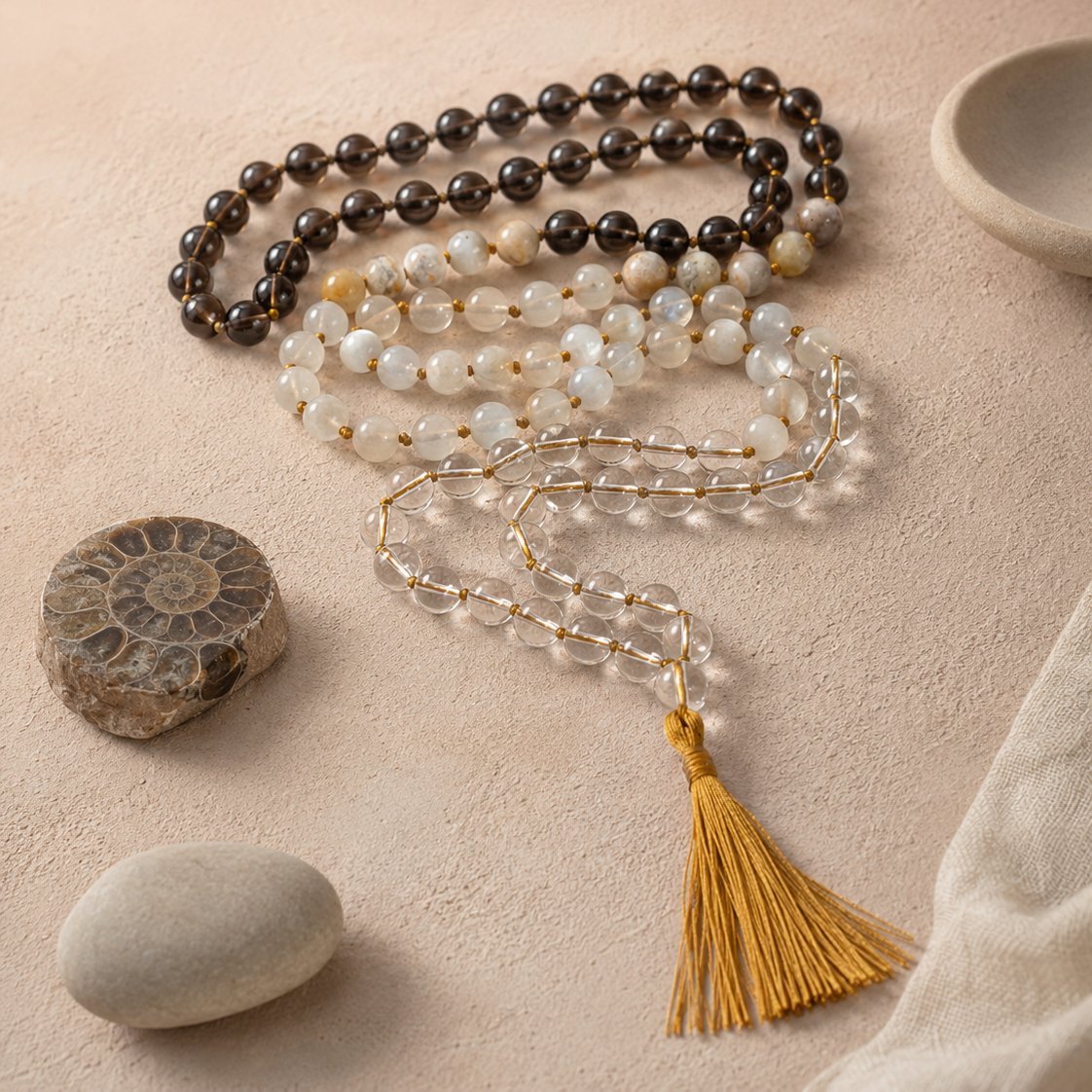
The objects that support a daily practice of return — chosen for presence, not for performance.
The Shunya Space makes incense rituals and japa malas for exactly this — something to breathe, something to hold, something to repeat. You can browse the incense collection or the mala collection.

Support
Typically replies within an hour