Cart
0
You may also like








It is not dramatic. There is no crisis. Nothing is technically wrong. And yet the thoughts keep arriving — one after another, like an inbox that refills faster than you can clear it.
You know the experience.
You are trying to do one thing — read, rest, have a conversation, fall asleep — and your mind is doing seventeen other things simultaneously. Revisiting the thing you said last Tuesday. Rehearsing the difficult conversation you have been avoiding. Planning something that doesn't need to be planned for three weeks. Worrying about something that may never happen. Worrying about the fact that you are worrying.
You have probably been told, at some point, to simply stop thinking about it. To focus. To breathe. Maybe you have tried meditation and found your mind too loud to sit with. Maybe you have downloaded the apps and followed the prompts and felt, after a few minutes, more frustrated than when you started.
Here is what I want you to know before anything else: this is not a willpower problem. It is not a discipline problem. It is not evidence that you are worse at peace than other people, or that stillness is available to everyone except you.
It is a nervous system problem. And nervous systems respond to very specific things — none of which are the instructions to simply calm down.
The mind that will not stop is, at its root, a mind that does not feel safe.
Not unsafe in a dramatic sense. Unsafe in the way the modern world has quietly trained us to be — always monitoring, always anticipating, always scanning for the next thing that needs attention. The constant stimulation of digital life keeps the prefrontal cortex — the part of the brain responsible for planning, analysing, and problem-solving — in a state of near-continuous activation.
A brain that is always planning is a brain that cannot rest. And a brain that cannot rest will find thoughts to think even when there is nothing that genuinely needs thinking about. It will manufacture concern because concern is what it has been trained to produce.
You are not an anxious person. You are a person whose nervous system has been asked to run a marathon every day and has forgotten that the race ends.

The instinct, when the mind races, is to try to resolve the thoughts. To reason with them. To work through them logically until they are finished. This is entirely understandable — and almost entirely ineffective.
The thinking mind cannot calm the thinking mind. You cannot think your way out of overthinking any more than you can run your way out of exhaustion. The tool that created the problem cannot be the tool that solves it.
What can interrupt the loop is something the thinking mind cannot argue with: the body. Specifically, the senses. A strong physical sensation, a specific scent, a tangible object held in the hands — these activate a different part of the nervous system, one that the analytical mind cannot easily override.
This is why grounding techniques work when nothing else does. Not because they distract you from your thoughts — but because they give the nervous system something real to attend to, something present and physical, while the thinking mind is still trying to win an argument with itself.
The first thing that genuinely interrupted my overthinking loop was not a breathing exercise or a meditation. It was a stone.
I started keeping a crystal on my desk — a piece of black tourmaline, chosen because someone whose judgment I trusted said it helped with mental noise. I was sceptical. But the act of picking it up, feeling its cool weight in my palm, running my thumb across its surface — this did something that I could not explain but could not deny.
The thoughts did not stop. But they quietened. The act of attending to something real and physical in the present moment gave my nervous system something to do that was not thinking.
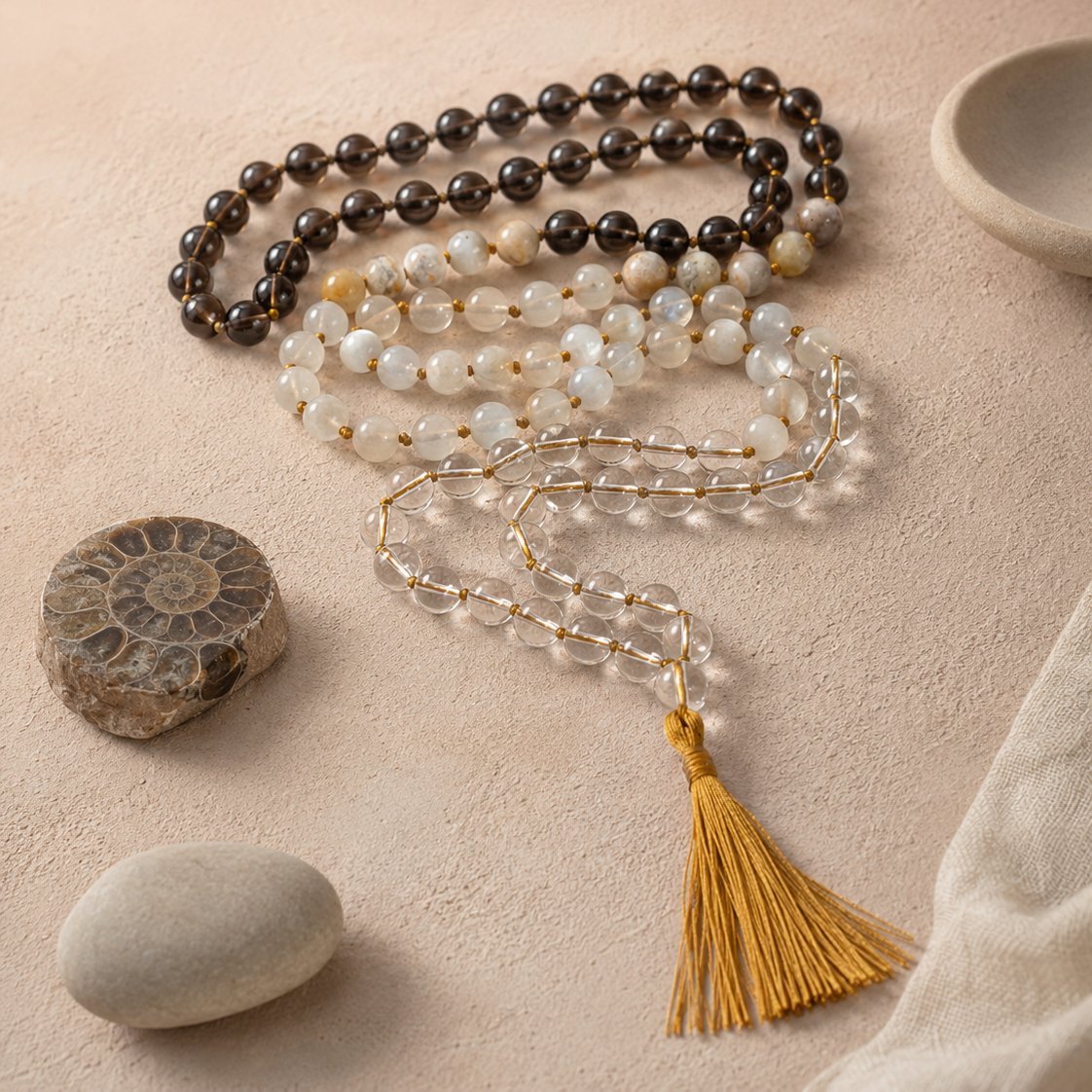
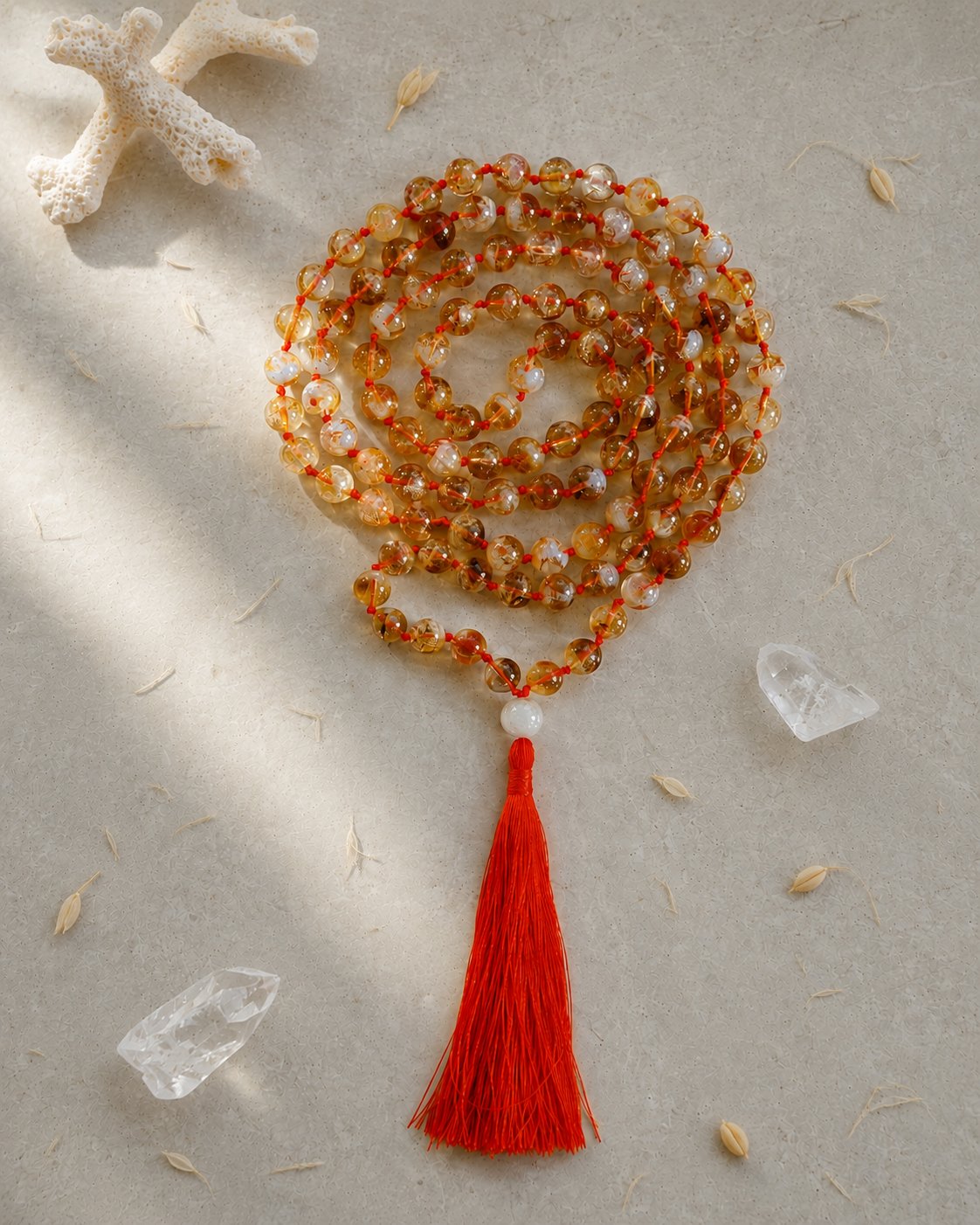
I later learned that this is precisely what the japa mala has been designed for across centuries — the movement of fingers from bead to bead gives the restless mind a task so simple and rhythmic that the analytical loop cannot sustain itself alongside it. The hands know what to do. The mind, given this gentler occupation, begins to slow.
Scent bypasses the thinking mind entirely. It is the only sense with a direct pathway to the limbic system — the part of the brain where emotion and memory live, and where the threat-response is housed.
I began burning incense when my mind was at its most active — not at night, but in the afternoon, when the accumulation of the day had made my thoughts particularly loud. The smell of sandalwood or frankincense did not solve any of the things my mind was circling. But it created a break in the loop — a moment of involuntary sensory presence that the analytical mind could not maintain its grip through.
Used consistently at the same time each day, a specific scent becomes a cue — one the nervous system learns to associate with the instruction: you can stop now.
Overthinking is, in its structure, a form of repetition. The same thoughts, cycling. The same concerns, returning. The mind is already in a loop — the question is only which loop it inhabits.
Replacing the anxious loop with a conscious one — the movement of a mala, the repetition of a simple phrase, the counting of ten breaths — does not require the thoughts to stop. It simply gives the repetitive nature of the anxious mind a different track to run on. A gentler, chosen one.
This is the oldest technology for mental stillness in the world. Every culture has its version — the rosary, the mala, the prayer beads, the mantra. They endured not because of faith alone, but because they work. Because the rhythmic repetition of a simple act is one of the few things that can interrupt the involuntary repetition of anxious thought.
Not a programme. Not a commitment. Just one thing, once, to see what it feels like.
The next time your mind begins to loop — before you try to reason with it, before you pick up your phone, before you do anything — pick up an object. Feel it. Only that, for thirty seconds.
A crystal. A smooth stone. A mala bead. Anything with weight and texture that is real and present and asks nothing of you.
Notice what happens in those thirty seconds. Not what you think about it. What happens in your body. In your shoulders, your jaw, your breath.
That small, almost embarrassingly simple act is the beginning of something the ancient world understood very well and the modern world has largely forgotten: that the body is the fastest way back to the present moment, and the present moment is the only place the anxious mind cannot follow you.
Your mind is not your enemy.
It is doing exactly what years of overstimulation have trained it to do.
The practice is not about silencing it. It is about giving it something better to do.
The objects that help interrupt the loop — crystals, malas, incense — and the practices that go with them.
The Shunya Space makes japa malas and incense rituals for exactly this — something to hold, something to breathe. You can browse the mala collection or the incense collection.

Support
Typically replies within an hour