Cart
0
You may also like

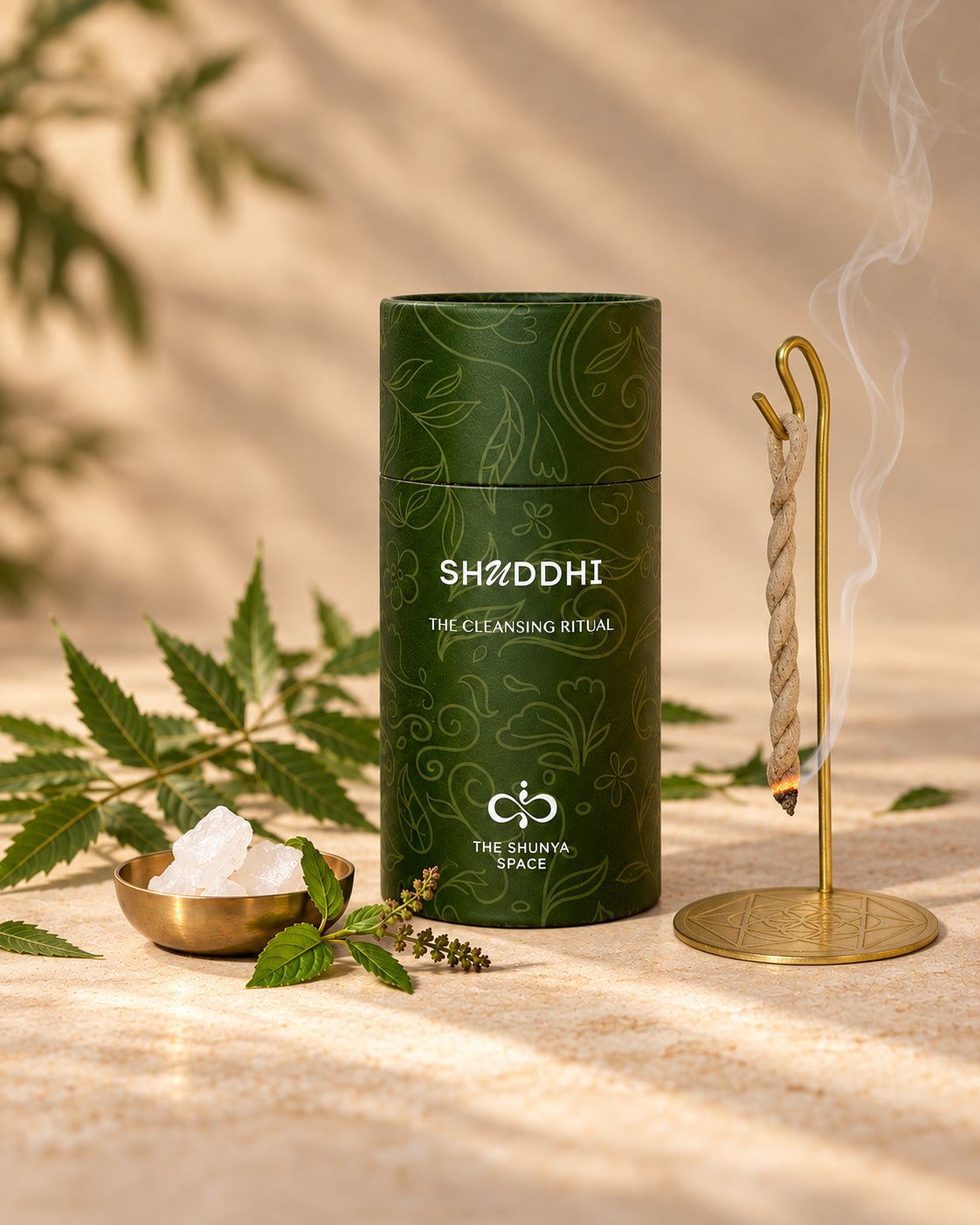
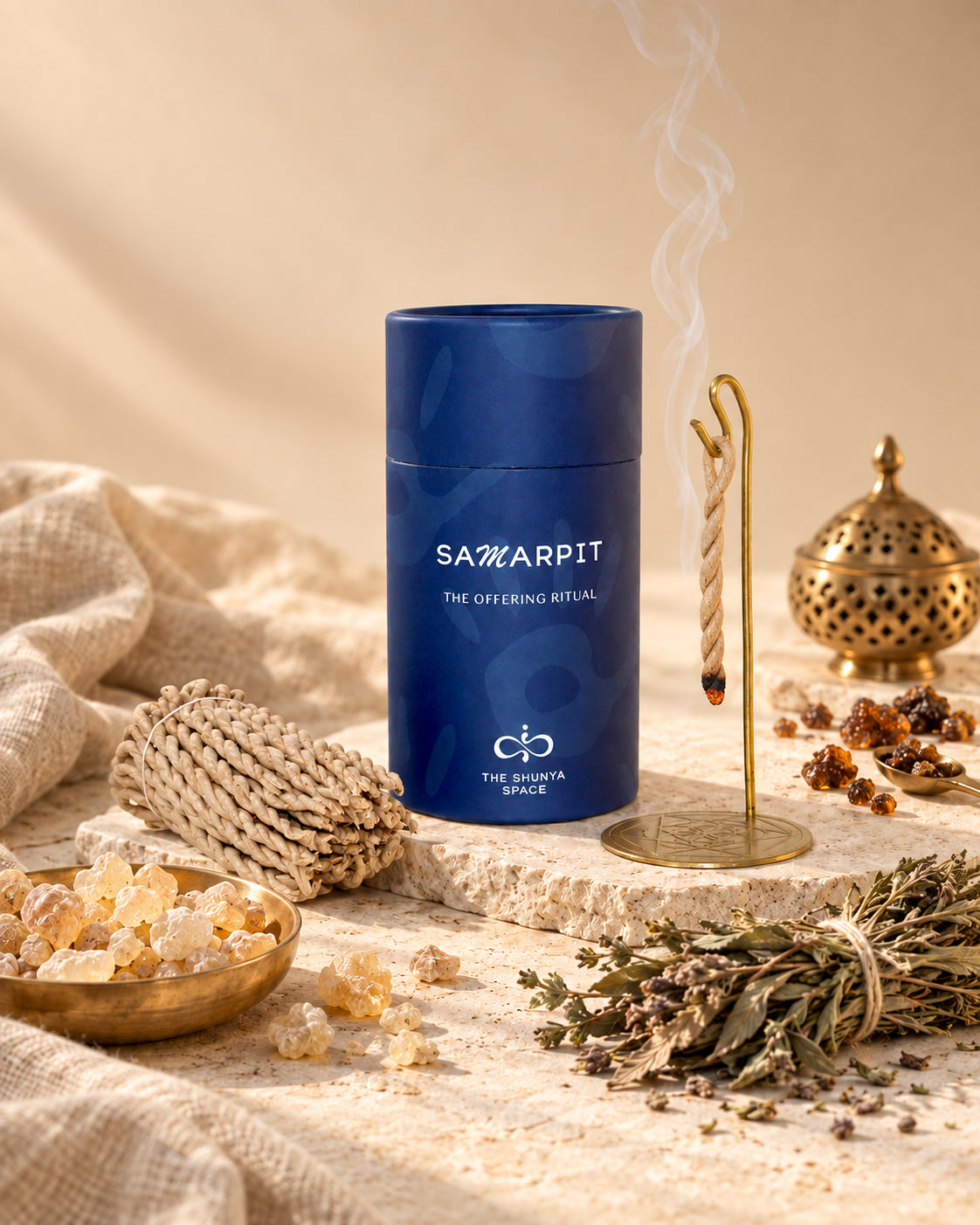
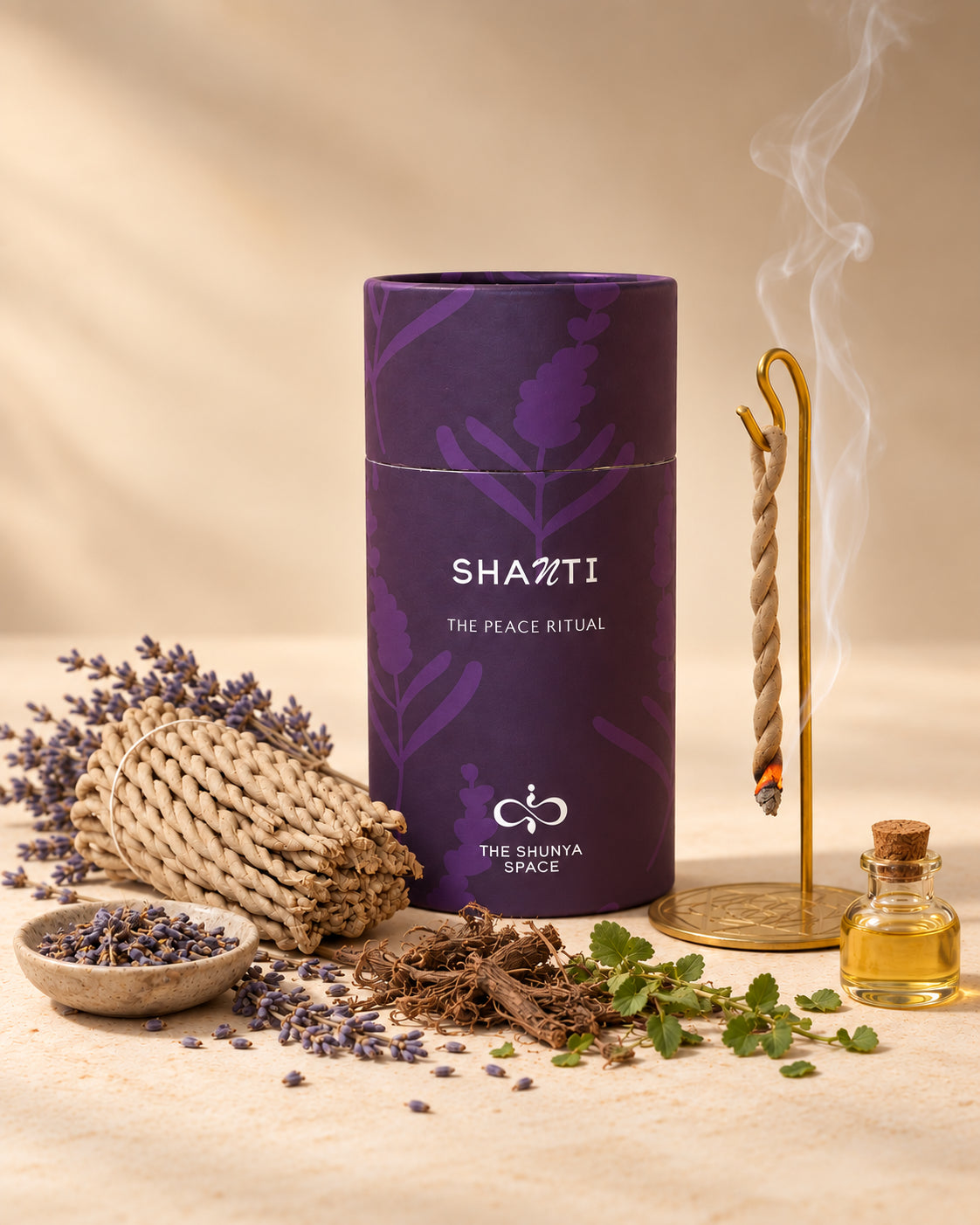


The incense rope — rassi dhoop (रस्सी धूप) — is one of the oldest aromatic ritual forms of the Himalayan world. Powdered herbs, resins and fragrant woods are rolled inside a strip of handmade Lokta bark paper and twisted tightly into a cord. There is no bamboo stick at its centre and no charcoal in the blend, so the smoke carries the ingredients themselves: earthier and softer than a stick, closer to the smoke that has filled temples and mountain shrines for centuries.
Each rope burns for fifteen to twenty minutes. The ritual that follows asks for about the same.
In the Vedic tradition, smoke is understood as a carrier — a medium between the physical and the subtle. The Sanskrit word dhupa — which gives us dhoop — refers specifically to aromatic smoke offered in ritual contexts. It is not decoration. It is transmission. The smoke rises, carrying intention with it, making visible something that would otherwise remain invisible.
From a purely sensory perspective: smell is the only sense with a direct neural pathway to the limbic system — the part of the brain that governs memory, emotion, and the sense of being grounded or ungrounded. A scent can change your internal state faster than any thought can. The woods, herbs and resins that go into rope incense — sandalwood, juniper, marigold, camphor — have been burned across traditions to mark a space as set apart, and to invite a quality of alert stillness. Not calm in the collapsed sense. Awake in the settled sense.
This is the environment the ritual is designed to create. No belief is required. Scent and attention do the work together.
Most Indian homes know two kinds of incense well.
Agarbatti is a fragrant paste coated around a thin bamboo stick, often with charcoal in the base to help it burn. When it finishes, the bamboo core is left behind.
Dhoop cones and sticks are a denser, stick-free paste. They give a fuller, heavier smoke from a small shape.
Rope incense sits apart from both. Powder is rolled in Lokta paper, and paper and powder burn together as one slow ember. With no stick and no charcoal, what you smell is the blend itself, carried on a thin, steady line of smoke.
Fifteen to twenty minutes. The rope will tell you when it is done.
Keep burning incense within sight, on a stable surface, away from curtains, paper and small hands.

Simply watch. No mantra, no technique, no goal. Observe the smoke. Notice how it never takes the same shape twice, never goes where you expect, never stops moving. This is not a metaphor you need to work with. Let it simply be interesting to watch something that cannot be controlled.
So Hum with the breath. If the mind is restless, anchor it. On each inhalation: So. On each exhalation: Hum. The scented breath becomes the mantra's vehicle. One rope of this is a complete practice. You can read more about this mantra in सोहम् (Soham).
Japa with a mala. If you keep a mala, let the rope burn beside you while you move through a round of 108. The scent marks the beginning; the beads keep you there. Our beginner's guide to the japa mala walks you through it.
Sankalpa reflection. Hold the word you arrived with and ask, without urgency: what would this look like today? A quality rather than a plan. What would presence look like in this particular morning, in these particular circumstances? Let the answer come slowly, or not at all. The asking is the practice.
Each Sugandha rope holds a single intention. Choose the one that matches the morning you are walking into.
Sama — sandalwood, for meditation. Warm, woody Himalayan sandalwood, offered in temples and burned before dhyaana for centuries. Light Sama when you sit for meditation or japa, or when you want the room to settle before you begin.
Aarambh — marigold, for beginnings. A marigold, sandalwood and camphor blend that honours Shree Ganesha, remembered at the start of every new undertaking. Light it on the first morning of something new, or whenever you are setting a sankalpa.
Nirmal — Himalayan juniper, for clearing. Wild-harvested mountain juniper, burned for centuries to cleanse and mark a space. Light it when a room feels heavy, after guests leave, or when you want to begin again. Walk it slowly through the space with a window open.
The smoke carries what the mind cannot hold. This is the practical function of ritual. When you set a sankalpa and let it rise with the smoke, you have externalised something internal. Made it visible, however briefly. Placed it somewhere outside the endless loop of thought.
The ritual does not guarantee a better day. It does not promise that what you set as intention will unfold as you hoped. What it does — reliably, quietly, over time — is create a morning that belongs to you before it belongs to anyone else. That is not a small thing. That is, for most people, the thing they miss most without knowing what it is.
One rope. Every morning. Before anything else.
What is rope incense made of?
Powdered herbs, resins and fragrant woods, rolled inside a strip of handmade Lokta bark paper and twisted into a rope. There is no bamboo stick and no charcoal.
How long does rope incense burn?
Each Shunya rope burns for fifteen to twenty minutes.
How do you light rope incense?
Light the tip, let the flame burn for a moment and settle into a glowing ember, then rest the rope in a brass stand or heat-safe dish with the lit end free.
Is rope incense the same as dhoop batti?
Both are free of a bamboo core, but dhoop batti is usually a pressed stick of paste. Rope incense is a powder blend rolled in paper, which gives a thinner, steadier smoke.
The rope incense and ritual sets described here are made by The Shunya Space. You can see them in the Sugandha incense collection.

Support
Typically replies within an hour